
- No health body sets an age; parents usually stop between ages 2 and 4, once the child can call out or come to you.
- For at least the first 6 months, the AAP and the NHS advise the baby sleeps in your room. A monitor does not replace that.
- Keep the monitor while it catches wakings you would miss: another floor, white noise, a big bed near the stairs, an illness.
- A one-week test settles it: each time the monitor wakes you, check whether you could hear your child without it.
When should you stop using a baby monitor at night?
When it no longer tells you anything you would miss. The usual age is between 2 and 4, says Los Angeles pediatrician Edmond Sarraf (Reviewed, March 2024). By 4, the same article notes, a child can say clearly what they need and come to get you.
No health body sets an age for switching the monitor off. The AAP, the NHS and the CPSC give rules for where a baby sleeps and where a cable goes, not for when the monitor goes. So the real test is your own home: its walls, its doors, and how deeply you sleep.
The first months are a different case. The AAP advises sharing a room with your baby for at least the first 6 months, and says it can cut the risk of SIDS by as much as 50 % (HealthyChildren.org). It also says there is no evidence that home heart and breathing monitors lower that risk. A sound or video monitor does one thing: it carries a waking to wherever you are. The table lines up the rules that do exist.
| Age | Sleeps | Monitor at night |
|---|---|---|
| 0–6 months | your room | optional |
| 6–12 months | crib | yes |
| 1–2 years | crib | yes |
| 2–3 years | bed | yes |
| 3–4 years | bed | test |
| 4 and up | bed | rarely |
| Age | What the official advice says | What the night monitor does |
|---|---|---|
| 0–6 months | Sleep in your room, in the baby's own crib (AAP, NHS). Over 90 % of SIDS deaths happen before 6 months (NICHD). | Little at night: you are in the room. Optional. |
| 6–12 months | Their own room is a family choice. SIDS is less common after 8 months; the safe-sleep rules last until the first birthday (NICHD). | Carries a cry from another room. Keep it on. |
| 1–2 years | The crib while it is safe. Monitor cables out of reach as the child grows (CPSC). | Night wakings, teething, fevers. Usually keep it on. |
| 2–3 years | A bed once the child is taller than 35 in. (89 cm), the rail is at mid-chest, or they climb out (AAP, via Cleveland Clinic). | Tells you the child is up and walking. Keep it on in the first weeks in a bed. |
| 3–4 years | No rule | The child can call you or come to you. Often not needed: run the test below. |
| 4 years and up | No rule | Rarely tells you anything new. Off, unless there is a reason. |
From the AAP (HealthyChildren.org, updated September 11, 2026), the NHS (reviewed November 25, 2025), NICHD Safe to Sleep, the U.S. CPSC (February 11, 2011) and Cleveland Clinic on the AAP's crib limits (October 1, 2025), all opened November 11, 2026. Whether to keep the monitor on is this page's rule of thumb, not official advice.
Baby sleeping in the next room: do you still need a monitor?
Usually yes, for the first year or two. A wall and a closed door can turn soft fussing into silence, and a fan or white noise hides the rest. The monitor is what lets you close the door at all. If you hear your baby's first whimper from your bed, with the doors as they are at night, you may not need one.
The move itself has some support. In a Penn State study of 279 first-time mothers, babies who slept in their own room by 4 months slept 40 minutes more a night at 9 months than babies still in their parents' room (Paul et al., Pediatrics 2017; Penn State). At 30 months, children who slept on their own by 9 months slept over 45 minutes longer each night. The study shows a link, not a cause, and the AAP's advice on the first 6 months still stands.
Many toddlers find their voice again later, calling out after lights-out. The toddler sleep regressions explain why. The monitor helps you tell a real need from a stall.
Does a 3-year-old need a baby monitor?
For hearing, most don't. A child of three can usually call out, climb out of bed and walk to your room. Keep the monitor for a reason, not out of habit:
- A big bed near stairs or an outside door. In the first weeks out of the crib, the monitor tells you the child is up. A stair gate does more for safety than a camera.
- A bedroom far from yours. Another floor, the far end of a long flat, or a parent who sleeps with earplugs.
- An illness. A fever or a croupy cough, for a few nights.
- A medical need. If your child's doctor asks you to watch at night, follow their plan. A home monitor is not a medical device.
- Big changes. A new sibling, a move or a new bed, until the nights settle.
Two things change at this age. The first is the cable. The CPSC counted seven children strangled by baby monitor cords between 2004 and early 2011 (CPSC), and a toddler reaches farther every month. Keep the cable out of reach, and check again after the move to a bed: where to put the camera and its cord.
The second is privacy. An older child knows the camera is there. Tell them what it is for, and take it down when the reason is gone.
Do you need a baby monitor in an apartment?
Not always. In a small flat, with the bedrooms side by side and the doors open, you may hear every cry without one. A few things make a monitor worth it even there: white noise in the nursery, a fan or air conditioner in your room, a closed door, a parent who sleeps deeply, or evenings at the far end of the flat. The test below answers it for your home in a week.
If you only need one for a year or two, you don't have to buy one. An old phone from a drawer can be the camera, and your own phone the screen: an old phone as a baby monitor. The baby monitor cost calculator shows what each kind costs over the years you use it.
How to phase out the monitor: a one-week test
Under every age sits one question: does the monitor still tell you something your own ears would miss? A week of short notes answers it. Pick an ordinary week, with no illness, trip or new bed.
- Keep the night as it is. Same doors, same fan, same white noise. The test only counts in your real setup.You know which doors and sounds you are testing with.
- Turn the speaker down, but leave the alerts on. Set it low enough that your own ears get a chance to come first. Keep the lights, the vibration or the cry alerts, so nothing slips through.A loud cry should reach you through the wall before the monitor does.
- Each time the monitor wakes you, listen for a moment. Can you hear your child without it? Or is your child already at your door?In the morning, write one word for each waking: "heard" or "missed".
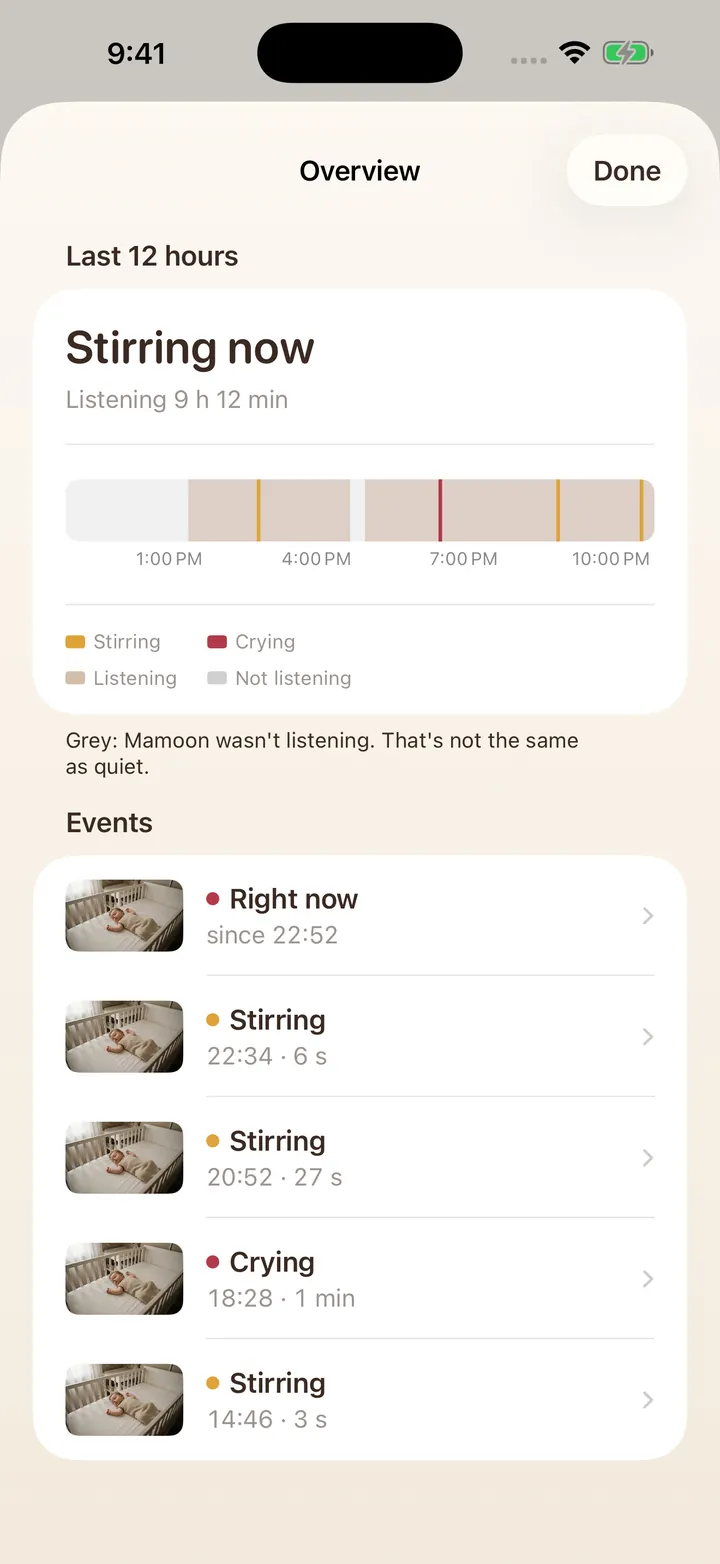
- Check the night's record, if your monitor keeps one. Compare it with your notes, to see the wakings that settled on their own.Mamoon's overview lists each stir and cry of the last 12 hours with its time.
- Decide at the end of the week. Every waking "heard": the night monitor can go. Any "missed": keep it, or step down to sound alone with alerts for crying only.Run the test again after a move, a new sibling or a long illness.
More on setting up and placing a monitor: baby monitor guides.
Where Mamoon fits
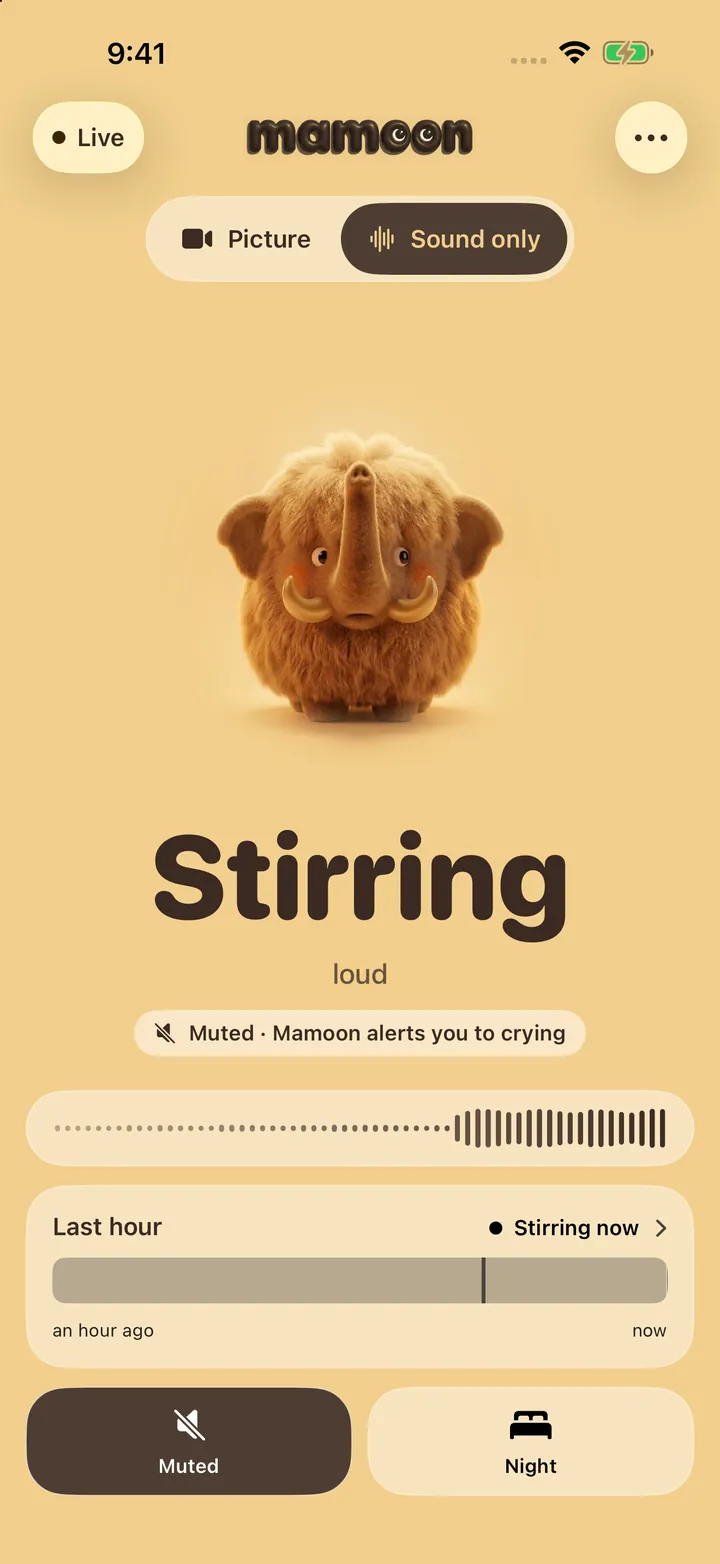
 Mamoon is a baby monitor app: an old phone by the crib is the camera, and your own phone is the parent screen. It lets you step down rather than switch off in one go. Sound only keeps listening without the picture. Set the level to only crying, and toddler chatter no longer wakes you (how cry detection works). Cry alerts keep coming with the sound muted. Mamoon has no breathing sensor and is not a medical device. Sound and cry alerts are free; the picture is $29.99 once or $3.99 a month after 14 days free.
Frequently asked questions
Do you leave the baby monitor on all night?
Yes, while it still catches wakings you would miss. Set the volume so a cry wakes you but rustles and sleep noises don't. A monitor that alerts only to crying lets you turn the live sound off and still be woken.
Can a baby monitor prevent SIDS?
No. The AAP says there is no evidence that home heart and breathing monitors lower the risk of SIDS. What lowers it: back to sleep, an empty crib, and your room for at least the first 6 months.
When should you take the baby monitor out of the room?
When a week of nights shows you hear every waking yourself, or your child comes to you. For many families that is between ages 2 and 4. Move the camera sooner if you cannot keep its cable out of reach.
Is it bad to keep a baby monitor for a five-year-old?
Not if there is a reason: an illness, a medical need, or a bedroom far from yours. Without a reason, it mostly keeps you checking a screen. Tell your child the camera is there and what it is for.
What can replace a baby monitor for an older child?
A door left ajar, a dim hallway light, a stair gate, and a clear rule that they may come to your room at night. A child who can open doors needs a gate more than a camera.
Sources
- AAP, HealthyChildren.org: A parent's guide to safe sleep (updated September 11, 2026) and Moon R.Y. et al., Sleep-Related Infant Deaths: Updated 2022 Recommendations, Pediatrics 2022, opened November 11, 2026
- NHS: Sudden infant death syndrome, same room for every sleep for at least 6 months (reviewed November 25, 2025) and NICHD Safe to Sleep: SIDS by baby's age, opened November 11, 2026
- U.S. CPSC, release 11-127: strangulation deaths in baby monitor cords (February 11, 2011), opened November 11, 2026
- Paul I.M. et al., Mother-infant room-sharing and sleep outcomes in the INSIGHT study, Pediatrics 2017 (abstract) and Penn State via ScienceDaily, June 5, 2017 (279 mothers), opened November 11, 2026
- Cleveland Clinic: from crib to toddler bed, the AAP's 35-inch limit (October 1, 2025) and Reviewed: when to stop using a baby monitor, Dr. Edmond Sarraf (March 26, 2024), opened November 11, 2026
Spotted a mistake or an outdated figure? Write to [email protected].
How these pages are made: an AI model drafts them from our own tests, real app screens and the sources listed, and Jan Drábek checks every page before it goes live.
