
- Of 13 baby monitors, 5 send the baby's video through makers' servers, 2 may train AI on it (CuboAi, Owlet), 4 share data for ads.
- All of it is in the makers' own words: privacy policies, Google Play and App Store labels and websites, read on November 6, 2026 (Nanit's policy, for one). How this was checked.
- The picture stays at home with the radio monitors that have no app (Infant Optics, HelloBaby) and with the apps that work over your Wi-Fi (Cloud Baby Monitor, Dormi, Mamoon).
- Two minutes on an app's store page tell you most of this for any monitor; the steps are below.
- Mamoon is ours, checked by the same rules.
Where does the baby's video go tonight?
Down one of three roads. A radio monitor sends the picture across the house to its parent unit and nowhere else. Infant Optics says it plainly: "There is no IP address involved. There is no route to the internet
" (Infant Optics).
A cloud monitor sends the picture to the maker first. Nanit calls it a feature: your stream "can only be pushed by Nanit's secure servers to your mobile device
", and video is stored only "if you've opted into a Nanit Insights Plan
" (Nanit). The live view of your crib passes through a company, plan or no plan.
A phone app on your Wi-Fi takes the third road. Cloud Baby Monitor "uses by default only your home WiFi network to transmit live audio and video between the devices. No internet connection is required
" (Cloud Baby Monitor's FAQ). The picture goes from the phone by the crib to your phone through your own router, and that is the whole trip.
| Tonight's video | Radio monitor | Cloud monitor | App on your Wi-Fi |
|---|---|---|---|
| Where it goes | Across the house to the parent unit | To the maker's servers, then to your phone | From the crib phone or camera to your phone, through your router |
| Who holds it on the way | nobody | the maker | nobody; some apps use a relay when you are away |
| Account with the maker | none | yes | usually none |
| Checked here | Infant Optics, HelloBaby | Nanit, Miku, CuboAi, VTech, Bibino | Cloud Baby Monitor, Dormi, Baby Monitor 3G, Mamoon |
The monitors sorted by the road their maker describes. Owlet, eufy and Annie are missing: their policies do not say.
Who keeps the video, and for how long?
Once the picture reaches a server, how long does it stay? The makers answer in days, tied to plans: Nanit's Memories subscribers "can view up to 2 days of past full Video History
", Milestones subscribers "up to 7 full days
" (Nanit memberships).
| Monitor | Video on the maker's side | Kept for | Its words |
|---|---|---|---|
 Nanit | yes, live and history | 2 or 7 days, on a paid plan | "up to 2 days of past full Video History" (Nanit) |
 Miku | yes | 3 days, longer for a fee | "3-Days of Activity Video Storage" (Miku) |
 CuboAi | yes, on Google Cloud | 7 days for event thumbnails | "upload the recorded audio and video data to Google Cloud" (CuboAi) |
 Owlet | clips | 14 days, on a paid plan | "14 days of history saved in your Owlet Dream App" (Owlet360) |
 VTech (Wi-Fi models) | yes | until the plan ends or storage is full | "transmitted to the servers of VTech or its service providers" (VTech) |
 Bibino | yes | 21 days, on Premium | "audio and video recordings, photos … are stored for 21 days" (Bibino) |
 Baby Monitor 3G | away from home only | nothing kept | "the communication has to run through our server", end-to-end encrypted (TappyTaps) |
 Dormi | relay when needed | nothing kept | "no recordings stored in the cloud" (Dormi) |
 Cloud Baby Monitor | no, by default | nothing kept | "uses by default only your home WiFi network" (Cloud Baby Monitor) |
 Mamoon (ours) | no | nothing kept | picture and sound stay on your home Wi-Fi (Mamoon's policy) |
From the policies and plan pages linked in each row, read November 6, 2026. eufy and Annie do not say; Infant Optics and HelloBaby have no app to keep anything.
The apps that work over your Wi-Fi mostly have nothing to keep. The whole picture, five questions per monitor:
| Monitor | |||||
|---|---|---|---|---|---|
| Nanit | yes | yes | yes | – | 34 |
| Miku | yes | yes | yes | – | 28 |
| CuboAi | yes | yes | no | yes | 28 |
| Owlet | clips | yes | may | may | 22 |
 eufy | ? | yes | may | asked | 20 |
| VTech | yes | yes | yes | – | 8 |
| Bibino | yes | Prem. | yes | – | 3 |
| Baby Monitor 3G | away | no | some | – | 7 |
 Annie | ? | opt. | some | – | 1 |
| Cloud Baby Monitor | no | opt. | no | – | 1 |
| Dormi | relay | no | no | – | 0 |
 Infant Optics | no | no | store | n/a | 6 |
 HelloBaby | no | no | store | n/a | – |
| Mamoon (ours) | no | no | no | no | 0 |
- Video via servers
- Does the baby's picture go through the maker's servers? away: only while you watch from outside the home. relay: an end-to-end encrypted relay when the phones cannot link directly. clips: recorded clips; the policy is silent on live video. ?: the policy does not say.
- Account
- Must you create an account before you see the picture? Prem.: Bibino Premium only. opt.: optional, for one extra mode.
- Ads
- Does the policy share data for advertising? may: it says the sharing may count as a "
sale
". some: ad tracking events go to Meta. store: the maker's web store only; the monitor has no app. - AI
- May the maker train AI on your data? may: the policy allows it. asked: owners were asked to donate videos. –: the policy says nothing. n/a: no app, no data.
- Trackers
- Outside services the homepage loaded from an EU address before any cookie choice, November 6, 2026. –: store unavailable that day.
Who may train AI on your baby's recordings?
Two makers write it down. CuboAi: "The recordings will also be used to train CuboAi's algorithm to become increasingly better at recognizing dangerous situations for infants
". Its legal basis is "legitimate interest
", not your consent. Objecting "may prevent you from continuing to use our service and products
" (CuboAi). Your nights are the training set.
CuboAiprivacy policy, November 6, 2026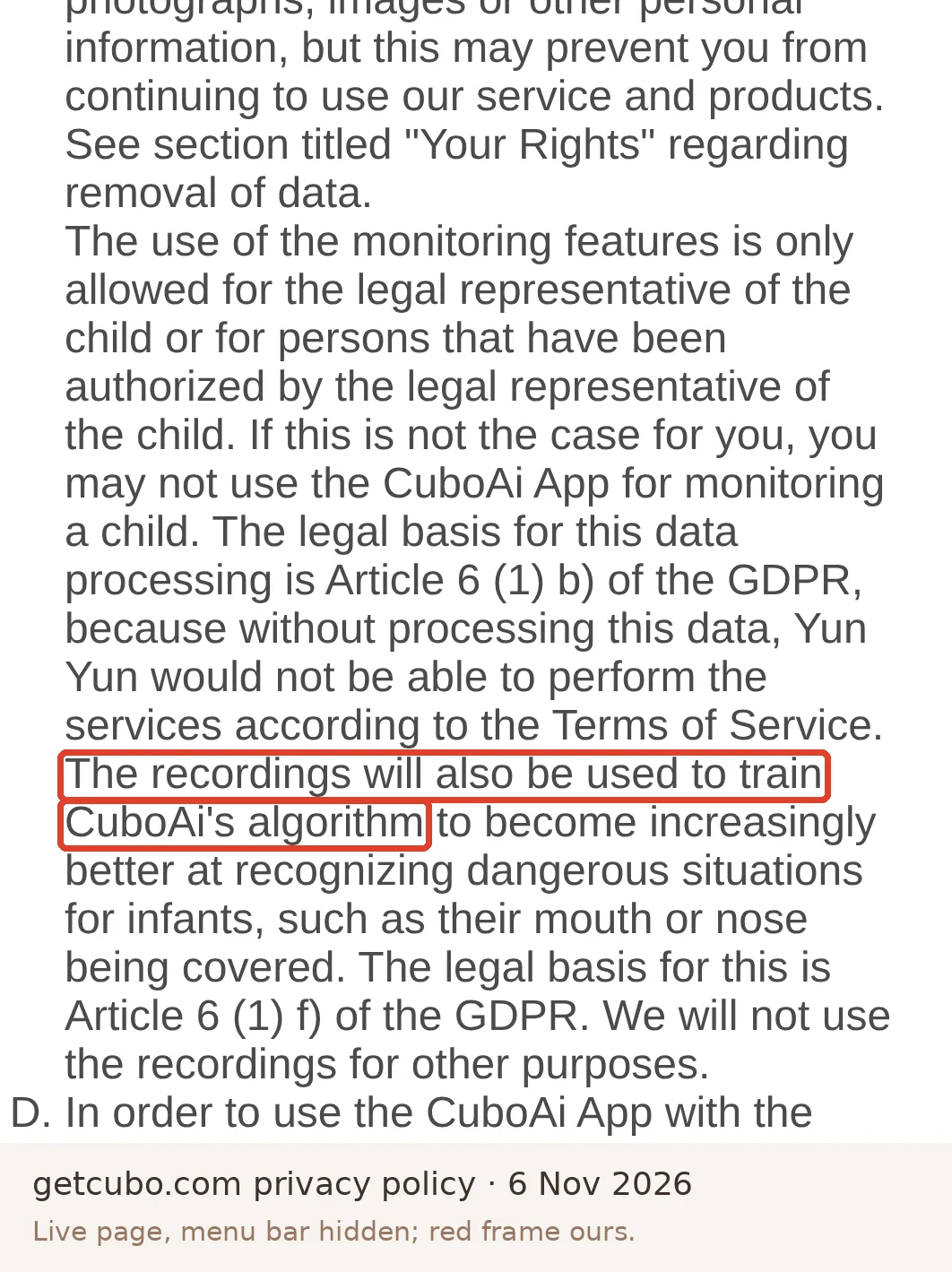 Screenshot: CuboAi (Yun Yun)
Owlet's policy, updated July 2026, says it may use your data "to develop and train artificial intelligence and machine learning models
" and may "collaborate with trusted research partners
" (Owlet). Its sock measures pulse and oxygen, so this is your baby's health data.
eufy took a third route: it asked. In 2025 it paid owners of its security cameras for videos to train its AI. It "also asks users to donate videos recorded with the company's baby monitors
" (TechCrunch, October 1, 2025). A request you can decline is one thing; training on every recording by default, as CuboAi's policy allows, is another.
Who shares your details with advertisers?
By the time the baby is asleep again, the data has a second life. Nanit's policy says: "We do share information with third parties for the purpose of cross-context behavioral advertising or targeted advertising
" (Nanit). Miku hands identifiers and web activity to "advertising networks
" (Miku). VTech may pass tracking data "with our business partners and advertisers
" (VTech). eufy concedes that its ad disclosures "may qualify as the sale of Personal Data
" under US state law (eufy).
The phone apps play the same game on a smaller scale. Bibino's free version shows ads, and its policy names AdMob and Facebook remarketing (Bibino). Annie shows none. It does tell Meta when you install, start a trial or subscribe, to "improve our advertising campaigns on Meta platforms
" (Annie). Dormi's website promises "zero ads, ever
" (Dormi). None of this touches the video; it shows what the maker does with the parent.
What happens before you even buy?
The website starts collecting first. Each homepage was opened once from an EU address, no cookie banner touched, and the outside services it loaded in about 11 seconds were counted (from the browser's own list).
Session recording" replays how a visitor scrolled and tapped (Microsoft Clarity). HelloBaby's store was down that day.
Nanit's homepage loaded 34 outside services, Meta's ad tracker and Microsoft Clarity among them; Dormi's loaded none (what Clarity records). Even a monitor with no app has a store: Infant Optics' homepage set Meta's cookie before any banner appeared. A tracker never sees the crib, but it shows how a company treats you before you have paid.
Can you trust the store labels?
Only as far as the maker filled them in. Both stores make an app declare what it collects and shares, and neither audits the form (Google's Data safety help).
Same app, two stores, different answers.
| App | Play: shared | Apple: tracking | Apple: own ads | Stores |
|---|---|---|---|---|
| Bibino | "No data shared" | Usage Data | none listed | disagree |
| Nanit | name, user IDs, app use, for "Advertising or marketing" | none | none listed | disagree |
| Miku | "No data shared" | none | name, e-mail, app use | consistent; its own ads only |
| Owlet | "No data shared" | none | rough location | consistent; its own ads only |
| Annie | app use and device IDs, for analytics | none | none linked | consistent |
| CuboAi | "No data shared" | none | none listed | consistent |
Three lines from each store, read November 6, 2026: data Google Play lists as shared with other companies; the App Store's "Data Used to Track You
"; App Store data linked to you for the maker's own advertising. "Disagree
" marks a row where the two forms contradict each other.
Bibino shares nothing on Play but tracks on Apple, where tracking means following you across "apps and websites owned by other companies
" (Bibino on the App Store). Nanit shares for advertising on Play but lists no tracking and no advertising purpose on Apple. Both labels are self-declared. And Google's "shared
" excludes the companies a maker pays to process data for it, so "No data shared
" can sit beside analytics or ad tools in the app (Google's definition).
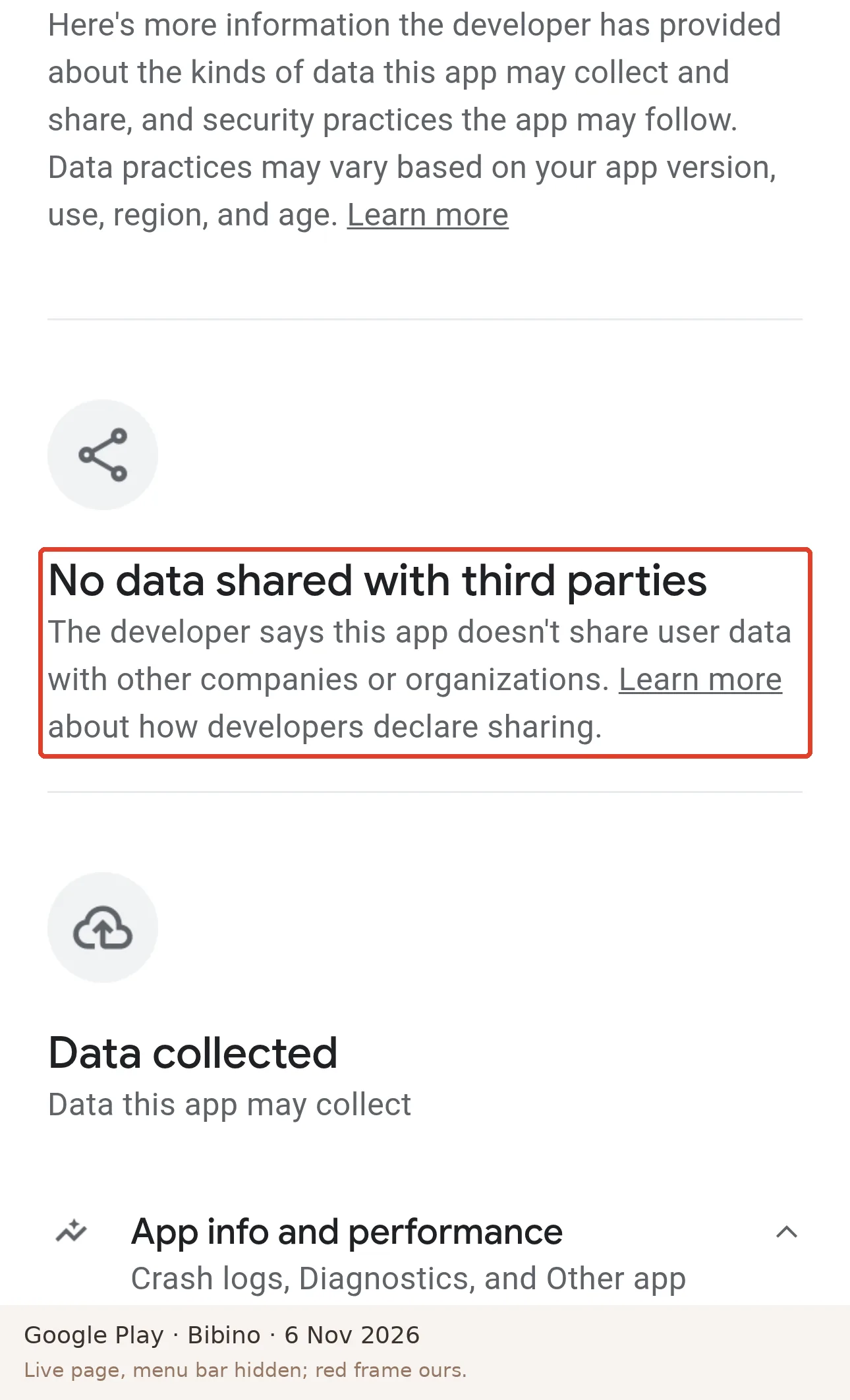 Screenshot:
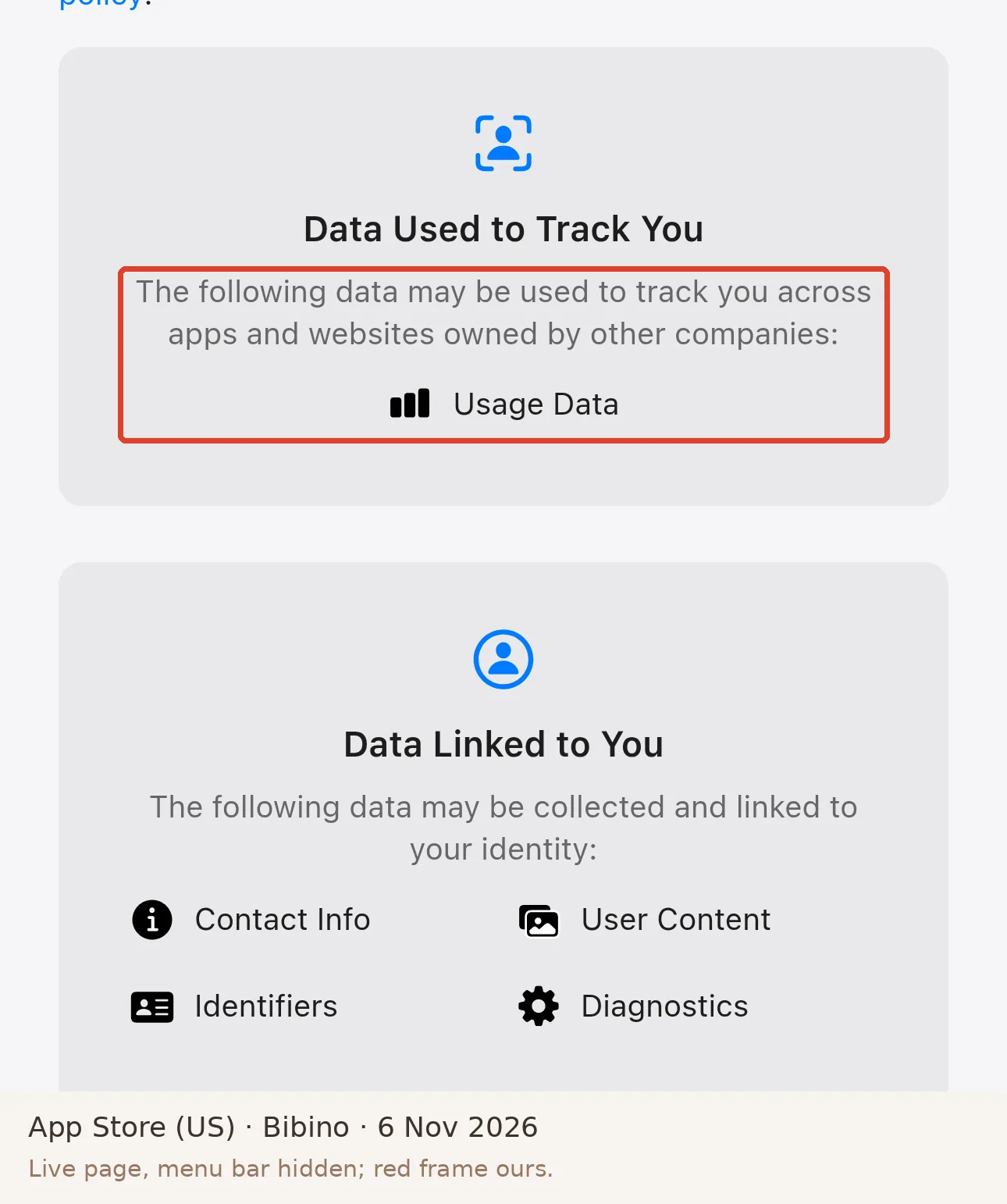 Screenshot: App Store (Bibino listing)…but the App Store also says"
Used to Track You: Usage Data"
Its App Privacy label.
Sexual orientation" among the data its app collects, required, for "
App functionality, Analytics, Advertising or marketing, Personalization" (Nanit on Google Play). What would a baby monitor do with that? Its privacy policy never mentions it, and no other app here ticks the box, so it may well be a box ticked by mistake. It is still what a parent reads on the store today.
NanitGoogle Play, Data safety, November 6, 2026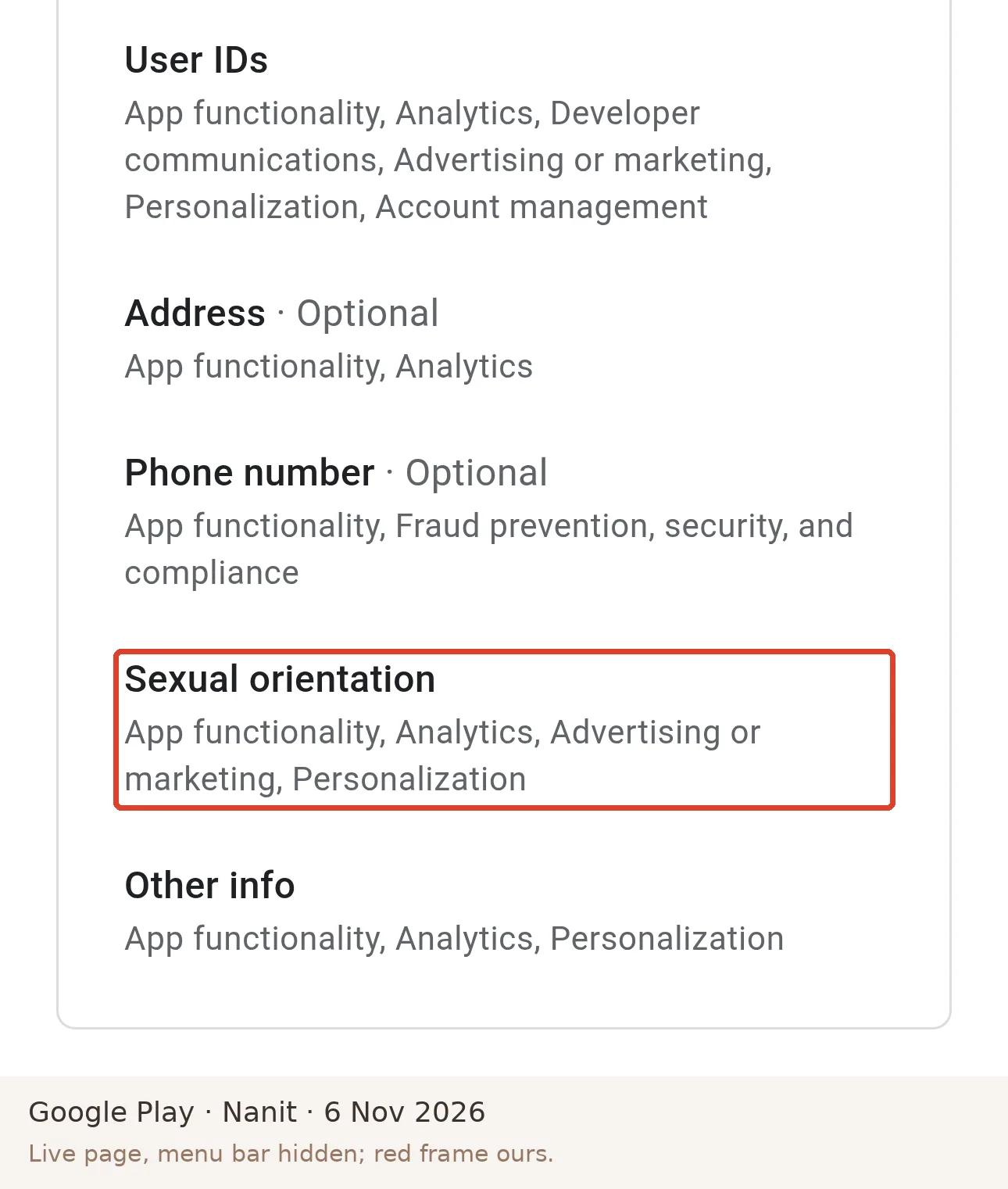 Screenshot: Google Play (Nanit listing)
Data collected" list, read November 6, 2026 (Google Play); red frame ours.
Check your own monitor in two minutes
- Google Play: find "
Data safety
" on the app's page and tap "See details
". Read "Data shared
" first, then look under "Data collected
" for "Advertising or marketing
".Each kind of data, its purpose, and whether it is optional. - App Store: find "
App Privacy
" on the app's page. The first box, "Data Used to Track You
", is the one to read.Empty is the best answer that box can give. - The privacy policy: open it and search for train, advertising, sale and retain.The hits: AI training, advertisers, how long video is kept.
- Setup: if the app wants an e-mail before showing a picture, the stream likely goes through the maker's servers.No account usually means the picture stays home.
How this was checked
To keep a monitor off the internet altogether, see a non-Wi-Fi baby monitor and is a baby monitor app safe. For what the cloud monitors cost over two years, see baby monitor subscriptions and Nanit vs Owlet.
Our verdict on each monitor
Our assessment, from the facts above, applied the same way to every monitor. Five concerns count: video through the maker's servers; AI training allowed, or videos asked for; data shared for advertising; store labels that disagree; an ad tracker before you accepted cookies. None is Best, one Good, two Mixed, three or more Poor.
- NanitPoorLive view only through its servers (road). Shares "
for the purpose of cross-context behavioral advertising
" (ads). Play and App Store forms disagree (labels). 34 services before consent (trackers) (policy). - MikuPoorVideo on its servers, "
3-Days of Activity Video Storage
" (retention). Identifiers go to "advertising networks
" (ads). Meta's ad tracker on the homepage (trackers) (policy). - CuboAiPoorRecordings on Google Cloud (retention), "
used to train CuboAi's algorithm
" without consent (AI). No ad sharing in the policy. Meta's ad tracker on the homepage (trackers) (policy). - OwletMixedPolicy silent on the video. May "
develop and train artificial intelligence and machine learning models
" (AI). Ad disclosures may count as "sharing
" (ads). No ad tracker seen (trackers) (policy). - eufyPoorDoes not say where baby-monitor video goes. Asked owners to donate videos for AI (AI). Disclosures "
may qualify as the sale of Personal Data
" (ads). Meta, Google and Reddit trackers before consent (trackers) (policy). - VTechMixedVideo "
transmitted to the servers of VTech or its service providers
" (retention). May share with "business partners and advertisers
" (ads). No ad tracker seen (trackers) (policy). - BibinoPoor"
The communication goes through our servers
", 21 days kept on Premium (retention). Ads in the free version (ads). "No data shared
" on Play, "Used to Track You
" on Apple (labels) (policy). - Baby Monitor 3GGoodAt home the stream stays between the phones; away it "
has to run through our server
", encrypted, nothing kept (retention). No account. Its app policy lists Meta's ad tracking (ads) (policy). - AnnieGoodNo ads, pairing by code. The policy does not say whether the stream is relayed (road). Sends install and subscription events to Meta (ads) (policy).
- Cloud Baby MonitorBest"
Uses by default only your home WiFi network
"; the internet only in its optional long-range mode (road). No ads, nothing kept. One outside service on the homepage (trackers) (policy). - DormiBestDirect link, or an end-to-end encrypted relay with "
no recordings stored in the cloud
" (retention). No account, "zero ads, ever
" (ads). Nothing loaded on its homepage (trackers) (policy). - Infant OpticsGoodNo app, "
no route to the internet
" (road). Its web store runs personalised ads and set Meta's cookie with no banner shown (trackers) (policy). - HelloBabyGoodNo app and no Wi-Fi, so no video leaves the house (road). Its web store says it has "
sold
" and "shared
" buyer data with marketing partners (ads) (policy). - MamoonOursWe might be biased: Mamoon is ours. Privacy is why it exists. Picture and sound go over your home Wi-Fi, not the internet. No account, no ads, no homepage trackers. One catch: anonymous usage counts, unless switched off in Settings.
Where Mamoon fits
Mamoon takes the third road: an old phone or a Wi-Fi camera is the camera, your phone the screen. It keeps working when the internet is down. It keeps no video history, and remote viewing needs your own Tailscale. Everything between the phone at the crib and the parent phones travels encrypted, and the parent phone checks it is the same crib phone it paired with.
The limits: anonymous usage counts go out unless you switch them off, and watching from away needs your own Tailscale. Sound and cry alerts are free; the picture is $29.99 once or $3.99 a month after 14 days free.
Frequently asked questions
Does Nanit record my baby all the time?
Nanit stores video only "if you've opted into a Nanit Insights Plan
": 2 days of history on Memories, 7 on Milestones (Nanit). The live stream passes through Nanit's servers either way.
Which baby monitor app works without an account?
Baby Monitor 3G, Dormi and Mamoon pair two phones with a code and ask for no e-mail. Cloud Baby Monitor needs an account only for its long-range mode. Nanit, Miku, CuboAi and VTech's Wi-Fi monitors all need one.
Does CuboAi use my videos to train its AI?
Yes, by its own policy: "The recordings will also be used to train CuboAi's algorithm
", on legitimate interest rather than consent (CuboAi). Objecting may stop you using the service.
Are radio baby monitors private?
The picture is: a radio monitor with no app sends it only to its parent unit, "no route to the internet
" in Infant Optics' words (Infant Optics). The makers' web stores still track buyers.
What does "No data shared
" on Google Play mean?
Less than it sounds. Google's definition excludes the companies a maker pays to process data for it, so an app with analytics or ad tools inside can still declare it (Google's Data safety help). Read the App Store label too.
Sources
- Nanit privacy policy (updated October 21, 2026), Nanit privacy and security page and Nanit memberships; Nanit Data safety on Google Play.
- CuboAi privacy policy (undated) · Owlet privacy policy (July 2026) and Owlet360 · Miku privacy policy (May 28, 2025) · VTech privacy policy (August 26, 2025) · eufy privacy policy (January 30, 2026).
- Bibino (April 10, 2025) and TappyTaps' privacy and security help page · Annie · Dormi (March 17, 2026) and its FAQ · Cloud Baby Monitor (April 4, 2019) and its FAQ.
- Bibino on Google Play and on the App Store.
- Infant Optics on its DXR-8 PRO; HelloBaby store privacy policy (February 1, 2025).
- TechCrunch: Anker offered to pay eufy camera owners to share videos for training its AI (October 1, 2025).
- The icons in the table and in the top image are each app's store icon (App Store or Google Play, fetched November 6, 2026), or the maker's site icon for Infant Optics and HelloBaby, shown to identify the products; the shield and the words are ours.
Spotted a mistake or an outdated figure? Write to [email protected].
How these pages are made: an AI model drafts them from our own tests, real app screens and the sources listed, and Jan Drábek checks every page before it goes live.
