
- Owlet if you want pulse and oxygen from an FDA-cleared sock. Nanit if you want an overhead camera, sleep data and nothing on the skin.
- The Owlet Dream Sock is a cleared medical device (FDA De Novo, November 2023). Nanit's Breathing Band is not; Nanit says so itself.
- Two years: Owlet Dream Duo $379.99 with the readings free, about $620 with Owlet360. Nanit Pro $289.99 alone, about $530 with the Memories plan.
- Both need Wi-Fi, the internet and the maker's account. Neither prevents SIDS, in the FDA's words and the AAP's.
- Want only to see and hear the baby, with cry alerts and no plan? A simpler monitor or a phone you own does that.
Nanit or Owlet: the short answer
Buy Owlet when the number you want at night is your baby's oxygen level. The Dream Sock is a Class II medical device for over-the-counter use. The FDA cleared it under De Novo DEN220091 on November 8, 2023, to notify you when pulse rate or oxygen leaves a preset range. The readings, cry detection and 48 hours of clips are free. The Dream Duo adds a 2K camera for $379.99 (Owlet, November 4, 2026).
Buy Nanit when you want the best picture of the crib and a record of the nights. The Nanit Pro looks straight down and tracks sleep. It watches breathing motion through a patterned band worn over pajamas: nothing on the skin, nothing to charge. The camera is $289.99. Sleep reports, video history and cry alerts need an Insights plan, $120 or $300 a year (Nanit, November 4, 2026).
Buy neither for peace about SIDS. The American Academy of Pediatrics tells parents not to use home monitors "as a way to reduce the risk of SIDS", and not to "let these devices give you a false sense of security" (AAP, updated September 2026). Both makers say the same in their fine print.
| Item | Owlet Dream Sock / Dream Duo | Nanit Pro + Breathing Band |
|---|---|---|
| What it measures | pulse rate and oxygen from the foot; sleep states | breathing motion seen by the camera; sleep, with a plan |
| FDA status | cleared: De Novo DEN220091, Class II, product code QYU (the sock) | not a medical device: "neither regulated nor approved" by the FDA (Nanit) |
| Ages | 1–18 months, 6–30 lbs | 0–24 months, 6–30 lbs |
| On the baby | a sock with a sensor, charged daily (up to 16 hours) | a fabric band over pajamas, or Nanit pajamas; nothing to charge |
| Price | sock $299.99; sock + camera $379.99; camera alone $99.99 | camera with floor stand or wall mount $289.99; band $19.99 |
| Free without a plan | live readings and alerts, live video, cry detection, 48 hours of clips | live video, sound and motion alerts, breathing motion, two-way audio, two users |
| The plan | Owlet360, $9.99/mo or $99.99/yr: reports, trends, 14 days of clips; US only | Insights: Sleep free for 3 months, then Memories $120/yr or Milestones $300/yr; cry alerts and history need one |
| Camera | Dream Sight, 2K, 130 degrees, night vision, two-way talk, temperature and humidity | 1080p overhead; 130 degrees on the Flex Stand; nightlight, white noise, temperature and humidity |
| Needs | Wi-Fi, the internet, the maker's app and account; the video goes through the maker's servers | |
| Warranty | 1 year | 1 year |
Prices and features from owletcare.com, nanit.com and Nanit's help center, opened November 4, 2026; the FDA record from the FDA's database. US prices.
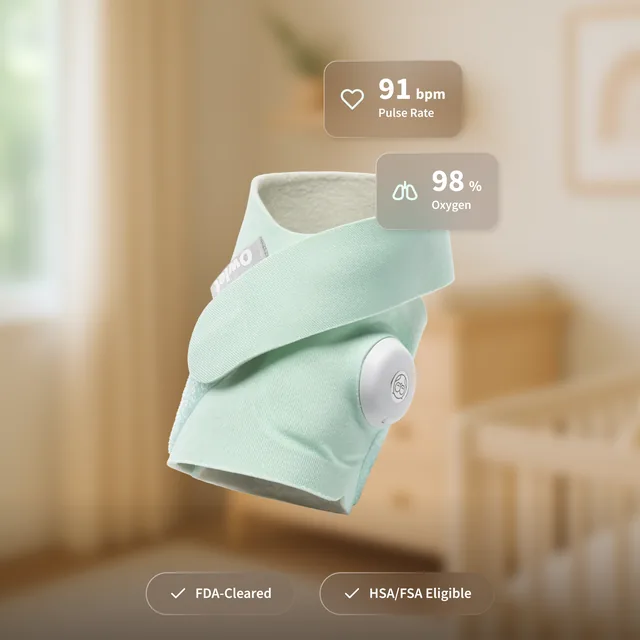 Photo:
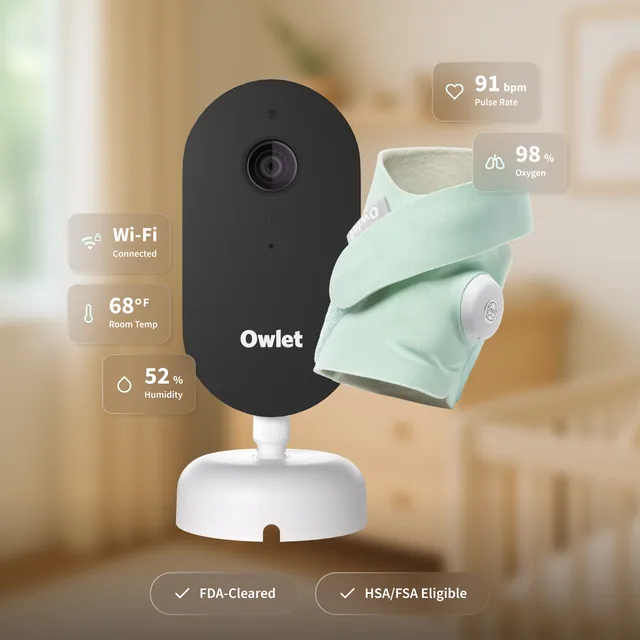 Photo:
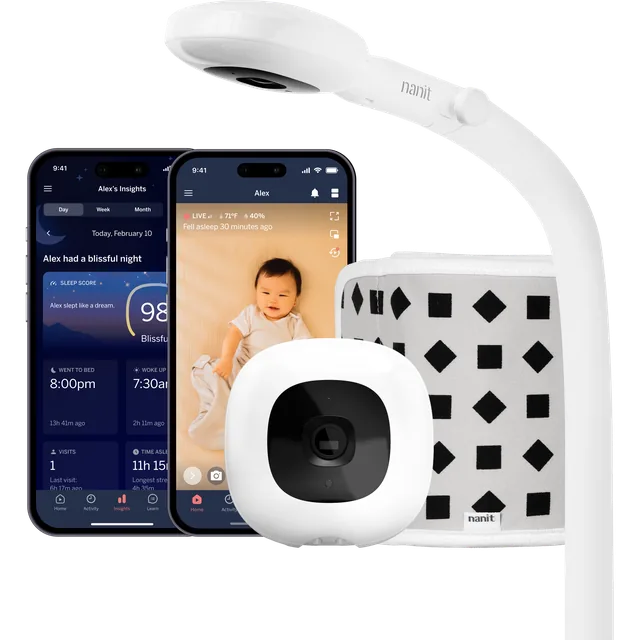 Photo: NanitNanit Pro + Breathing Bandnot a medical device
The overhead camera reads the band's pattern as the chest moves.
The sock or the band: what each measures, and what the FDA says
The Owlet sock holds a pulse oximeter, the sensor a clinic clips to a finger. The FDA's order says the Dream Sock identifies "when the infant's pulse rate and/or oxygen saturation moves outside a preset range, and provides a notification to the caregiver, prompting them to assess the infant" (FDA, DEN220091). It is cleared for infants aged 1–18 months who weigh 6–30 lbs.
The same order draws the limits. The sock is "not intended to provide notification for every episode". It is "not intended to replace traditional methods of monitoring, diagnosis or treatment". It is not for infants with a known heart or lung condition (FDA). Those babies get Owlet's prescription device, BabySat ($699, 510(k) K222597).
The Nanit band measures nothing on the body. The camera watches a black-and-white pattern on a band or on Nanit pajamas. When the pattern has not moved for 20 seconds, a Red Alert sounds on your phone and on the camera (Nanit help center).
Nanit's safety page says: "Nanit is not a medical device… It is not intended to diagnose, treat or cure any disease or other condition, including but not limited to, Sudden Infant Death Syndrome (SIDS)." It adds that false positive and false negative readings "are a potential risk of Nanit" (Nanit). The band is for babies 0–24 months and 6–30 lbs, in "families with healthy infants".
- Oct 2021The FDA wrote to Owlet that the earlier Smart Sock was sold "without marketing clearance or approval". Owlet stopped US sales (FDA warning letter).
- Nov 2023The Dream Sock was classified as an "infant pulse rate and oxygen saturation monitor for over-the-counter use", Class II, product code QYU (FDA database).
- Sep 2025The FDA told parents: "Do not use unauthorized infant monitors that claim to measure vital signs", breathing included. "No devices, including infant monitors, have been authorized to prevent SIDS or SUID." It names no brand (FDA safety communication).
False alarms: what parents actually report
Parents in a January 2026 r/NewParents thread mostly agree on one thing. Most Owlet "false alarms" are fit alerts, not health alerts. "The base turns yellow and the sound is completely different," a parent of twins wrote. Red alerts do happen: "In 9 months we've gotten 2 false alarms." A parent of a 13-month-old stopped: "it's always when he's tucked into a little ball basically laying on his owlet."
The Nanit band fails differently. It has to be snug: "Otherwise, it won't move with the baby when they breathe." It needs the pattern in view: "You CANNOT use it with a regular swaddle" (same thread). Nanit's help center agrees: "improper use of Breathing Wear may lead to false alerts" (Nanit). In BabyGearLab's test the Nanit "did not experience any false alarms", but it "doesn't alarm in the nursery", only on the phone and the camera (BabyGearLab, November 2024).
So a sock can slip and a band can sag. Each then alerts on the fit before it alerts on the baby. Whether that costs you sleep is the real question. "All it did was make my wife stay up all night watching the vitals," one father wrote. Another: "Owlet was great for our anxiety. Worth every penny" (r/NewParents, March 2025, June 2026).
What each costs over two years
Most comparison pages quote prices from 2022 to 2024 and "a year of Insights free". Nanit's membership page now gives the Sleep plan 3 months free, and all plans are billed yearly (Nanit, November 4, 2026). Here is what two years come to at the makers' own prices.
Two things the chart cannot show. Owlet's readings, alerts and cry detection stay free for as long as you own the sock. Owlet360 adds reports, trends and 14 days of clips instead of 48 hours (Owlet). Nanit's cry alerts, video history and sleep analysis all sit inside the plan. What each Nanit plan buys, and how to cancel, is on the Nanit subscription page; the whole market is in which monitors need a subscription.
Wearables wear out. A replacement Dream Sock sensor is $129 and extra fabric socks $49.99; a Nanit band is $19.99 and the pajamas $29.99 (Owlet, Nanit, November 4, 2026). The cost calculator adds up your own mix.
Video, the app and Wi-Fi
On picture, the newer Owlet camera caught up. The Dream Sight (Gen 3) streams 2K with night vision and two-way talk. Owlet's own FAQ compares it with "1080p on Owlet Cam 2", the camera most older reviews tested (Owlet). Nanit Pro is 1080p, but it looks straight down from the wall mount or floor stand. That view is what sleep tracking and the band need. On the Flex Stand it "offers a 130 degrees view instead of a full overhead view", with no sleep tracking (Nanit).
On the app, parents' reports favour Nanit. PureWow's testers called the Nanit "the better choice for most parents because of its reliable connection" (PureWow, August 2024, with the older Cam 2). A June 2026 Owlet camera owner: "It's very laggy and buggy" (r/NewParents). Both apps have good and bad months; read the newest store reviews before you buy.
On Wi-Fi, they are the same product. Each needs your router, the internet and an account, and the video passes through the maker's servers. Nanit lists its free features "via your Nanit App and an Internet connection" (Nanit). When the internet is down, so is the monitor. In a hotel, "most devices like the nanit require a travel router", one parent wrote (r/NewParents). The Owlet sock also needs its base station within about 30 ft (Owlet's spec sheet). What each maker’s policy says it does with that video, AI training included, is in baby monitor privacy.
| Your situation | Owlet | Nanit | A phone or local camera |
|---|---|---|---|
| Internet down, router on | stops | stops | works |
| Hotel Wi-Fi with a login page | travel router | travel router | two iPhones directly; others need a hotspot |
| Baby in an arms-in swaddle | sock works | band needs the chest in view | no readings anyway |
| Baby with a diagnosed heart or lung condition | BabySat, by prescription | not intended | not intended |
| Past 18 months | sock's indication ends | band to 24 months; camera for years | works |
| A sitter without the app | needs the app | needs the app | needs the app |
| Video never leaves the house | maker's servers | maker's servers | home Wi-Fi only |
From the makers' pages and the FDA order under Sources, opened November 4, 2026. See the travel guide and baby monitors without Wi-Fi.
Can you use Nanit and Owlet together?
Yes, and some parents do: the sock for the readings, the Nanit camera for the picture and the nights' record. "Own both. Owlet for us since we bed share. Our Nanit is just sitting there," one wrote (r/NewParents, August 2025). The two apps do not talk to each other, so it is two accounts, two sets of alerts and two chargers. A common pattern is the sock first and the camera for longer.
Which one fits you
Which one fits your family?
Tick what applies.
Tick what applies to your family and the answer appears here.
The same answers in plain words:
- Buy Owlet if you want pulse and oxygen from a cleared device, your baby sleeps in an arms-in swaddle, or you want readings and cry detection with no plan. Add the Duo for video.
- Buy Nanit if you want the overhead picture, sleep reports and a video history, nothing on the skin, and a yearly plan does not bother you.
- Buy neither if you want a monitor that stays on your home Wi-Fi with no account, you already own a phone or a Tapo camera, or you want to spend as little as possible. Picture, sound and cry alerts need none of the above.
- Use both if you want the sock's readings in the first months and the camera's record for longer. Budget for two accounts.
Where Mamoon fits
Mamoon is the third column: a baby monitor made from a phone you already own, or from a Tapo camera, with your own phone as the screen. It recognizes crying on the phone itself and wakes you with the nursery muted. Picture and sound go over your home Wi-Fi with no cloud and no account. It does not measure pulse, oxygen or breathing, keeps no video history, and is not a medical device. Away from home it works only through Tailscale. Sound and cry alerts are free; the picture is $29.99 once or $3.99 a month after 14 days free.
Frequently asked questions
Is Nanit or Owlet better for SIDS?
Neither is made for that. The FDA says no device, including infant monitors, has been authorized to prevent SIDS or SUID, and the AAP says not to use home monitors to reduce SIDS risk (FDA, AAP). Safe sleep is what lowers the risk.
Is the Owlet Dream Sock FDA approved?
It is FDA-cleared, not approved: a De Novo classification granted in November 2023 as a Class II over-the-counter monitor for pulse rate and oxygen, product code QYU, for infants of one to 18 months (FDA database). The earlier Smart Sock was not cleared and got a warning letter in 2021.
Is the Nanit breathing band FDA cleared?
No. Nanit's safety page says Nanit "is not a medical device" and that false positive and false negative readings are a potential risk (Nanit). Breathing Motion Monitoring is a free sleep feature, not a medical one.
Does Nanit or Owlet have more false alarms?
Parents report fit alerts on both: a yellow alert when the sock slips, a halt when the band is out of view. True red alerts are rare but real on both, and more common as the baby grows and kicks (r/NewParents). A snug fit cuts most of them.
Which is cheaper over two years, Nanit or Owlet?
Without plans: Nanit Pro $289.99 against the Dream Sock $299.99 or Dream Duo $379.99. With plans for two years: Nanit about $530 with Memories, Owlet about $620 with Owlet360. Owlet's readings need no plan; Nanit's cry alerts do.
Do Nanit and Owlet work without Wi-Fi?
No. Both need Wi-Fi, the internet and the maker's account, and the picture stops when the internet is down. A radio monitor, or two phones on your own Wi-Fi, keeps working; see baby monitors without Wi-Fi.
Sources
- FDA De Novo database: Dream Sock, DEN220091, granted November 8, 2023 and the classification order with the indications for use; 510(k) K222597, BabySat 3, June 16, 2023, opened November 4, 2026
- FDA warning letter to Owlet Baby Care, October 5, 2021 and FDA safety communication: Do Not Use Unauthorized Infant Devices for Monitoring Vital Signs, September 16, 2025, opened November 4, 2026
- American Academy of Pediatrics: A Parent's Guide to Safe Sleep (updated September 11, 2026), opened November 4, 2026
- Owlet: Dream Sock, $299.99, Dream Duo (Gen 3), $379.99, with the spec sheet, Dream Sight (Gen 3), $99.99, Owlet360, $9.99 a month after a 7-day trial, opened November 4, 2026
- Nanit: Nanit Pro camera, $289.99, with the FAQ and warranty, Nanit Insights plans: Sleep 3 months free, Memories $120/yr, Milestones $300/yr, Breathing Band, $19.99, opened November 4, 2026
- Nanit help center: Breathing Wear product use and safety and What are Red Alerts?, opened November 4, 2026
- r/NewParents: Nanit/Owlet false alarms (January 2026), Owlet vs Nanit, which one and why? (August 2025), using both at the same time (March 2025), Owlet vs Nanit monitor? (June 2026), opened November 4, 2026
- PureWow: Nanit vs Owlet, tested by parents (August 22, 2024) and BabyGearLab: Nanit Pro Complete review (November 26, 2024), opened November 4, 2026
Spotted a mistake or an outdated figure? Write to [email protected].
